Turn your mortgage into a wealth-building tool. Smith Manoeuvre strategies, tax-smart planning, and honest math from two Canadian mortgage strategists.
Canadian Banks Just Committed $250 Billion: How to Position Your Business to Access It
TD Bank's chief executive calls this "a defining period of investment and industrial growth." The numbers support him. Five major banks have just pledged $250 billion to deploy into Canadian sectors over the next five to ten years, and pension funds are moving another $100 billion back to domestic markets. For a mid-market business owner, this is a procurement opportunity: banks with quotas to meet, fund managers hunting for deal flow, and sector-specific capital ready to deploy.
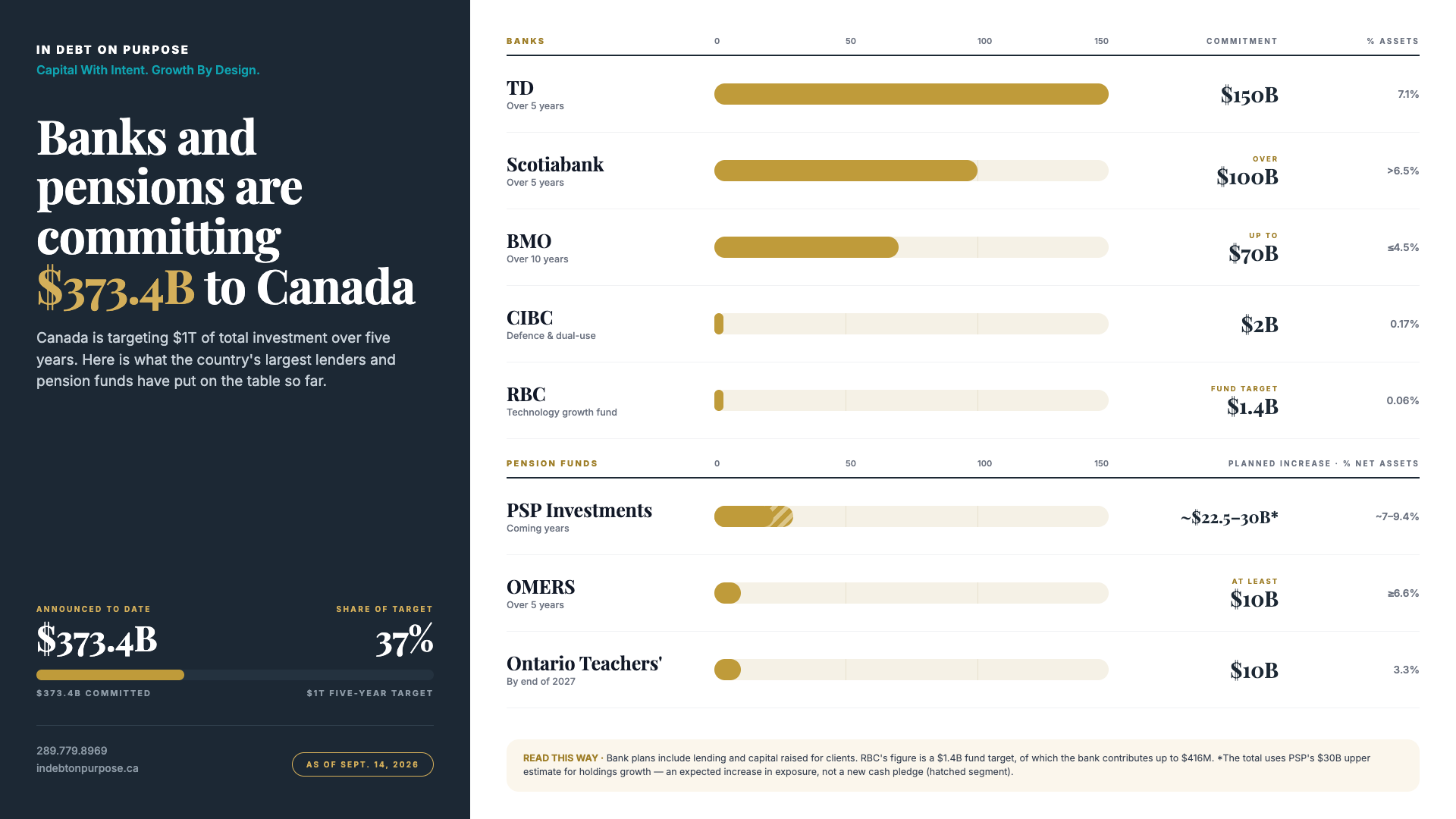
The capital isn't spread evenly. TD committed $150 billion over five years, focusing on energy, critical minerals, defense, AI, and roads, power grids, water systems, and data centers. Scotiabank committed $100 billion to the same sectors and launched the Scotia Growth Institute to advise on competitiveness, led by Kirsten Hillman, Canada's former ambassador to the United States. BMO is mobilizing $70 billion over ten years through bank financing and debt capital markets. CIBC carved out $2 billion specifically for small and mid-sized defense companies. RBC targeted $1.4 billion for Canadian technology firms.
Why this matters if you're under $50 million in revenue
These are debt mandates. But mandates create urgency. When a bank commits $2 billion to a sector, loan officers have quotas. When pension funds shift 30 to 40 percent of future investments back to Canada after years of buying abroad, fund managers need deal flow. The institutions are hunting for companies to back, and the hunting ground is deliberate: energy transition, critical minerals for EV supply chains, defense suppliers, AI integrators, and the roads, ports, power grids, water systems, and data centers those sectors require.
TD estimates $1 trillion in approved or pending projects across 300+ major builds in those categories. A trillion-dollar pipeline doesn't run on Fortune 500 contractors alone. It runs on mid-market fabricators, logistics providers, software integrators, and specialized service firms. If your business can plausibly slot into that supply chain, you now have leverage you didn't have in 2025.
The concrete moves
Align your business narrative with the priority sectors
Banks are filling quotas in named categories. If your company does commercial HVAC, frame your next pitch around data center cooling for AI server farms. If you're in logistics, lead with critical mineral transport or defense-sector distribution. The capital is sector-tagged. Make your ask fit the tag.
Get specific about scale-up capital, not working capital
Scotiabank's institute and TD's language both emphasize "helping businesses scale." That means expansion capital, not invoice factoring. Prepare a plan that shows how $500,000 or $2 million accelerates growth in a priority sector. Show the hires, the equipment, the contract pipeline. Banks deploying this capital are looking for companies that can absorb five-year capital and grow into regional players.
Track the 300 projects
TD named 300 approved or pending large-scale projects. Those are public filings. Search CMHC databases for federal and provincial road, bridge, water, and power projects; check provincial procurement sites; and search federal defense contracts. Find the prime contractors. Then position your firm as a qualified supplier before the RFPs hit. The work is already funded. The question is who captures the subcontracts.
Use the pension fund shift as proof of market
When you're pitching a lender or investor, mention that PSP Investment Board is bringing domestic assets above $100 billion and Ontario Teachers' Pension Plan is deploying an additional $10 billion by end of 2027. Institutional capital moving home is a signal that Canada risk has repriced. It makes your domestic growth story easier to sell.
The absorption question remains open. Whether the Canadian economy has enough shovel-ready mid-market firms to deploy $250 billion without driving up specialized labor and materials costs is unclear. But that's a 2028 problem. Right now, the capital is committed, the mandates are live, and the institutions are looking for companies that can take it and grow. Position accordingly.
Your next move
None of this works if your financing, your structure, and your growth plan aren’t already talking to each other. That’s the piece I help mid-market owners sort out. If you’re not sure where you’d stand in this shift, let’s talk!



TD Bank's chief executive calls this "a defining period of investment and industrial growth." The numbers support him. Five major banks have just pledged $250 billion to deploy into Canadian sectors over the next five to ten years, and pension funds are moving another $100 billion back to domestic markets. For a mid-market business owner, this is a procurement opportunity: banks with quotas to meet, fund managers hunting for deal flow, and sector-specific capital ready to deploy.
The capital isn't spread evenly. TD committed $150 billion over five years, focusing on energy, critical minerals, defense, AI, and roads, power grids, water systems, and data centers. Scotiabank committed $100 billion to the same sectors and launched the Scotia Growth Institute to advise on competitiveness, led by Kirsten Hillman, Canada's former ambassador to the United States. BMO is mobilizing $70 billion over ten years through bank financing and debt capital markets. CIBC carved out $2 billion specifically for small and mid-sized defense companies. RBC targeted $1.4 billion for Canadian technology firms.
Why this matters if you're under $50 million in revenue
These are debt mandates. But mandates create urgency. When a bank commits $2 billion to a sector, loan officers have quotas. When pension funds shift 30 to 40 percent of future investments back to Canada after years of buying abroad, fund managers need deal flow. The institutions are hunting for companies to back, and the hunting ground is deliberate: energy transition, critical minerals for EV supply chains, defense suppliers, AI integrators, and the roads, ports, power grids, water systems, and data centers those sectors require.
TD estimates $1 trillion in approved or pending projects across 300+ major builds in those categories. A trillion-dollar pipeline doesn't run on Fortune 500 contractors alone. It runs on mid-market fabricators, logistics providers, software integrators, and specialized service firms. If your business can plausibly slot into that supply chain, you now have leverage you didn't have in 2025.
The concrete moves
Align your business narrative with the priority sectors
Banks are filling quotas in named categories. If your company does commercial HVAC, frame your next pitch around data center cooling for AI server farms. If you're in logistics, lead with critical mineral transport or defense-sector distribution. The capital is sector-tagged. Make your ask fit the tag.
Get specific about scale-up capital, not working capital
Scotiabank's institute and TD's language both emphasize "helping businesses scale." That means expansion capital, not invoice factoring. Prepare a plan that shows how $500,000 or $2 million accelerates growth in a priority sector. Show the hires, the equipment, the contract pipeline. Banks deploying this capital are looking for companies that can absorb five-year capital and grow into regional players.
Track the 300 projects
TD named 300 approved or pending large-scale projects. Those are public filings. Search CMHC databases for federal and provincial road, bridge, water, and power projects; check provincial procurement sites; and search federal defense contracts. Find the prime contractors. Then position your firm as a qualified supplier before the RFPs hit. The work is already funded. The question is who captures the subcontracts.
Use the pension fund shift as proof of market
When you're pitching a lender or investor, mention that PSP Investment Board is bringing domestic assets above $100 billion and Ontario Teachers' Pension Plan is deploying an additional $10 billion by end of 2027. Institutional capital moving home is a signal that Canada risk has repriced. It makes your domestic growth story easier to sell.
The absorption question remains open. Whether the Canadian economy has enough shovel-ready mid-market firms to deploy $250 billion without driving up specialized labor and materials costs is unclear. But that's a 2028 problem. Right now, the capital is committed, the mandates are live, and the institutions are looking for companies that can take it and grow. Position accordingly.
Your next move
None of this works if your financing, your structure, and your growth plan aren’t already talking to each other. That’s the piece I help mid-market owners sort out. If you’re not sure where you’d stand in this shift, let’s talk!
Read Next
Three TSX Earnings Reports, Three Different Answers to the Same Economy
GICs or High-Interest Savings: The Break-Even Math as the Bank of Canada Turns Hawkish
Co-Buying a Home With a Friend Works Until Someone Wants Out
The Early Renewal Offer That Quietly Costs You Your Cheapest Months